

Square Wave Voltammetry for Biosensing
Potential step, Amplitude and Frequency

Electrochemical Insights is made possible entirely due to the support of its readers. If you find this work useful please consider becoming a paid subscriber. For just £3.50/month gain access to full length articles, weekly newsletters, actionable insights, downloadable tools, templates and hands-on tutorials for electrochemistry and biosensing research!
Join our growing community, where you can ask questions, share ideas, and showcase your own work. Your support helps keep this content going!

Electrochemical biosensors rely on sensitive and selective transduction of biological interactions into measurable electronic signals. Among the various voltametric techniques available, Square Wave Voltammetry (SWV) is particularly powerful due to its ability to enhance signal-to-noise ratio, improve detection limits, and provide rapid data acquisition. However, optimising SWV parameters—potential step, amplitude, and frequency—is crucial to achieving reliable and reproducible biosensor performance.
In this article, we will explore how these parameters influence signal characteristics and how to tailor them for biosensing applications.
1. Fundamentals of Square Wave Voltammetry
SWV is a pulsed electrochemical technique in which a staircase potential is superimposed with a square wave of defined amplitude and frequency. The net current is obtained by subtracting the current measured at the forward pulse from that at the reverse pulse, reducing background capacitance. This is because capacitive current responses are almost instantaneous to voltage changes, meaning it is nearly the same in both forward and reverse pulses. By subtracting the two measurements, the nearly identical capacitive components cancel out, while the Faradaic (redox) component, which depends on electron transfer kinetics, remains.
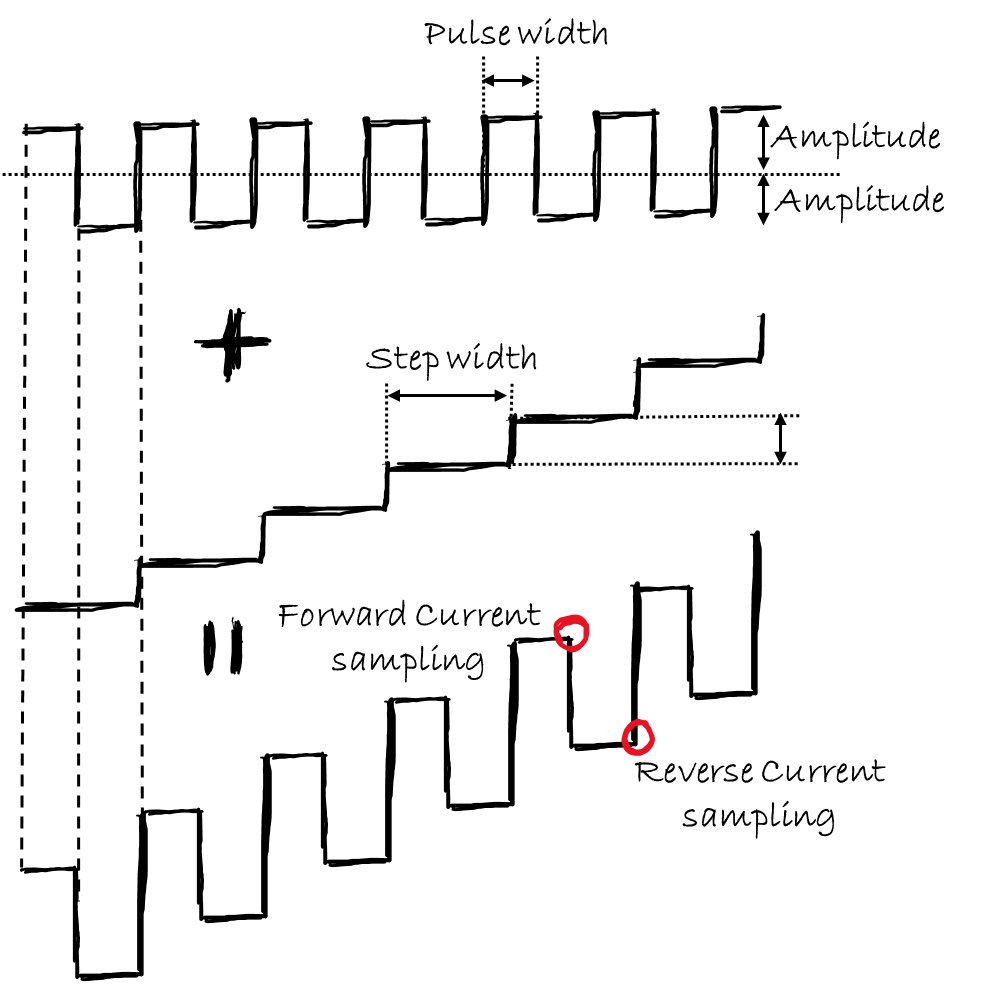
SWV is particularly advantageous for biosensing applications due to:
Enhanced Sensitivity: Differential current measurement cancels out capacitive charging contributions, isolating faradaic signals.
Rapid Measurement Time: High frequency allows fast data collection, reducing experimental duration.
Improved Peak Resolution: Enables better discrimination between multiple electroactive species, a key advantage in biosensor applications.
Lower Detection Limits: The differential nature of SWV improves detection limits compared to linear sweep voltammetry or cyclic voltammetry.
However, SWV is not as straight froward as other voltametric techniques such as cyclic voltammetry (CV). It is essential to optimise parameters such as potential step, amplitude, and frequency to ensure the kinetics of the redox process are accurately captured. Researchers often measure the system at a single frequency, and if no redox peak is observed, they may conclude that the reaction is undetectable. However, exploring a wider range of frequencies can reveal processes that remain hidden at one frequency but become apparent at another, offering deeper insights into the system’s electrochemical behaviour.
If you enjoy this content and would like to keep reading, please consider becoming a paid subscriber. For just £3.50/month get access to all Electrochemical Insights’ content .